
How to Choose a Custom Home Builder in Melbourne's South East
Most advice on choosing a builder starts and ends with "read the reviews and get three quotes". Both are worth doing. Neither protects you much on its own. Reviews tell you how a builder treated past clients when things went well. Three quotes are useless if they do not describe the same house.
The checks that actually protect you in Victoria are less exciting, mostly free, and take an evening. They also changed recently. The Building and Plumbing Commission replaced the Victorian Building Authority on 1 July 2025, and a new Home Warranty scheme replaced domestic building insurance for contracts signed from 1 July 2026. Plenty of guides online still describe the old system.
This is how we would choose a custom home builder in Melbourne's south east if we were on your side of the table, with the rules as they stand in October 2026.
The short answer
Before you sign with any builder in Victoria:
- Search the builder and the company on the Building and Plumbing Commission (BPC) practitioner register, and check the BPC's Compliance and Enforcement Register.
- Confirm the entity on the contract is the registered entity, and that its registration covers new homes (Domestic Builder Unlimited).
- Ask how the Home Warranty premium will be paid and when you will receive your Notice of Cover from the BPC.
- Check the deposit is no more than 5 percent on a contract of $20,000 or more, and that progress payments follow the legal stages.
- Compare quotes line by line, with particular attention to provisional sums, prime cost items and site costs.
- Walk through finished homes and a live site, not just a display home, and speak to past clients.

The most useful hour in the whole process is the one you spend reading the contract with the builder before you sign it.
Check 1: registration with the Building and Plumbing Commission
The BPC began operating on 1 July 2025 and took over the functions of the VBA, Domestic Building Dispute Resolution Victoria and the domestic building insurance arm of the VMIA.
Use the register, not the business card. The BPC's "Find and check a practitioner" page links to a public search where you can look up a builder by name, business name, registration number, location or type of work. The BPC's own advice is not to rely on advertising, quotes or what someone tells you.
Check the class. For a new home you want Domestic Builder (Unlimited), the class that covers domestic building work on Class 1, 2, 4 and associated Class 10 buildings. Limited classes, such as carpentry or framing only, do not cover building a whole house. Look for any conditions or limits on the registration.
Check the company too. A company can only enter into a major domestic building contract in its own name if the company itself is registered, and at least one director must hold registration in that class. If the person you are meeting is registered but the contract is in the name of a company that is not, stop and ask why.
Check the enforcement register. The BPC's Compliance and Enforcement Register shows certain disciplinary actions, prosecutions, suspensions and conditions. Not every complaint appears there, so a clean result is a good sign rather than a guarantee.
Ask about capacity. From 1 July 2026, domestic builders must meet Minimum Financial Requirements, which the BPC uses to assess financial capacity and set a Maximum Construction Capacity. You will not see the figure, but you can ask how many homes the builder is running now and who supervises each one.
Check 2: Home Warranty, the insurance that replaced DBI
If your contract is signed on or after 1 July 2026, the protection is called Home Warranty, and the BPC is the only provider. It applies to eligible work valued at more than $20,000, including a new home.
It is a big step up from the old domestic building insurance. DBI generally only paid out if the builder died, disappeared or became insolvent. Home Warranty can help where eligible work is incomplete, defective or non-compliant and the builder fails or refuses to complete or fix it. Total assistance can reach $400,000 per home, subject to eligibility, limits and exclusions. Major defects can be covered for up to 6 years after completion and other defects for up to 2 years.
How the premium works. The registered builder pays the premium, and it must be paid before the earlier of 10 business days after the contract is signed or the start of work. The BPC then issues you a Notice of Cover. Check that it shows the right builder name, registration number, ABN or ACN, site address, work covered and start of cover.
Older contracts. If you signed before 1 July 2026 and hold a DBI certificate, your cover stays under the DBI scheme, which applied to work over $16,000. It does not transfer to Home Warranty.
The deposit question. Consumer Affairs Victoria's guidance is still not to pay the deposit until the builder gives you a certificate of currency for your property. Under Home Warranty, ask the builder to confirm in writing when the premium will be paid and hold off on money until you are satisfied cover is in place.
Check 3: the money rules in the Domestic Building Contracts Act
By law, most domestic building work worth more than $10,000 needs a major domestic building contract, and the Domestic Building Contracts Act sets limits on what a builder can ask for and when.
| Payment | Legal limit for a contract to build all stages | When it is due |
|---|---|---|
| Deposit | 5% (contracts of $20,000 or more) | On signing, once insurance is sorted |
| Base | 10% | Footings or slab complete, depending on floor type |
| Frame | 15% | Frame complete and approved by the building surveyor |
| Lock-up | 35% | External cladding, roof, flooring, external doors and windows fixed |
| Fixing | 25% | Internal linings, doors, cabinetry, baths, basins and joinery fitted |
| Completion | The balance | When the work is complete under the contract |
Consumer Affairs Victoria describes this as the usual schedule and says to get legal advice if a contract proposes something different. Before each payment, check the stage has passed the building surveyor's inspection and is actually complete. Many owners pay an independent building inspector to check each stage.
Cooling-off. You can withdraw from a major domestic building contract within 5 business days of receiving a copy signed by the builder. You get your deposit back less $100 and any out-of-pocket expenses you approved. There is no cooling-off period if a lawyer reviewed the contract before you signed, so if you use a lawyer, do it properly and early.
Variations. Changes must be agreed in writing with the new price and completion date before the work is done, unless the builder reasonably believes the change will not need a permit change, cause delay or add more than 2 percent to the price. You should not have to pay for variations dealing with problems the builder should have foreseen, such as rock that a proper soil report would have shown.
Our post on what to look for in a custom home building contract goes through the clauses themselves.
How to compare quotes like for like
Three quotes for a custom home are only comparable if they price the same design, the same specification and the same site. They rarely do. This is how we would line them up.
Start from the same drawings. If each builder is pricing their own concept, you are comparing houses, not prices. Ideally, compare tenders on one set of working drawings and a written specification.
Separate the firm price from the allowances. Your contract must list every prime cost item and provisional sum, with a breakdown of how each estimate was reached. Add them up for each quote. A quote with $80,000 of provisional sums is not cheaper than one with $15,000, it just has more unknowns.
Check the site costs. Excavation, rock removal, retaining, drainage, crossovers and service connections are where low quotes recover their margin. Consumer Affairs Victoria specifically warns that excavation provisional sums can blow out if the soil report did not pick up rock. Ask whether each builder has a soil test and feature survey in hand before pricing.
List the inclusions in one place. Floor coverings, heating and cooling, window coverings, driveway, fencing, garden works, appliances, tapware level and ceiling heights. Some builders include these as standard. We include floor coverings, heating and cooling. Others leave them out of the headline number.
Compare the process, not just the price. Who manages the site, how often you get updates, how selections are made, and what the warranty looks like after handover. Our custom builder vs volume builder guide covers why these differ so much between business models.
Red flags worth walking away from
- A deposit above 5 percent on a contract of $20,000 or more, or any request for money before the insurance position is clear.
- A quote well below the others with large provisional sums for site works, or a fixed price given before anyone has tested the soil.
- Pressure to sign, such as a discount that expires this week or a builder who discourages you from getting the contract reviewed.
- A payment schedule that runs ahead of the work or does not match the legal stages.
- A mismatch between the person and the entity, where the registered builder is not the party signing the contract.
- Vague answers about who will run your site, or a site supervisor shared across a large number of jobs.
- Verbal variations, or reluctance to put changes and their cost in writing.
Questions to ask before you sign
- What is your registration number, and which entity will sign the contract?
- How many homes do you have under construction now, and who will be my site manager from start to finish?
- Which councils have you built in over the last two years?
- Have you had a soil test and survey done, and what site classification are you designing for?
- Which items are provisional sums or prime cost items, and how did you arrive at each figure?
- How do you price and approve variations?
- When will the Home Warranty premium be paid, and when will I receive the Notice of Cover?
- Can I visit a finished home and a current site, and speak to the owners?
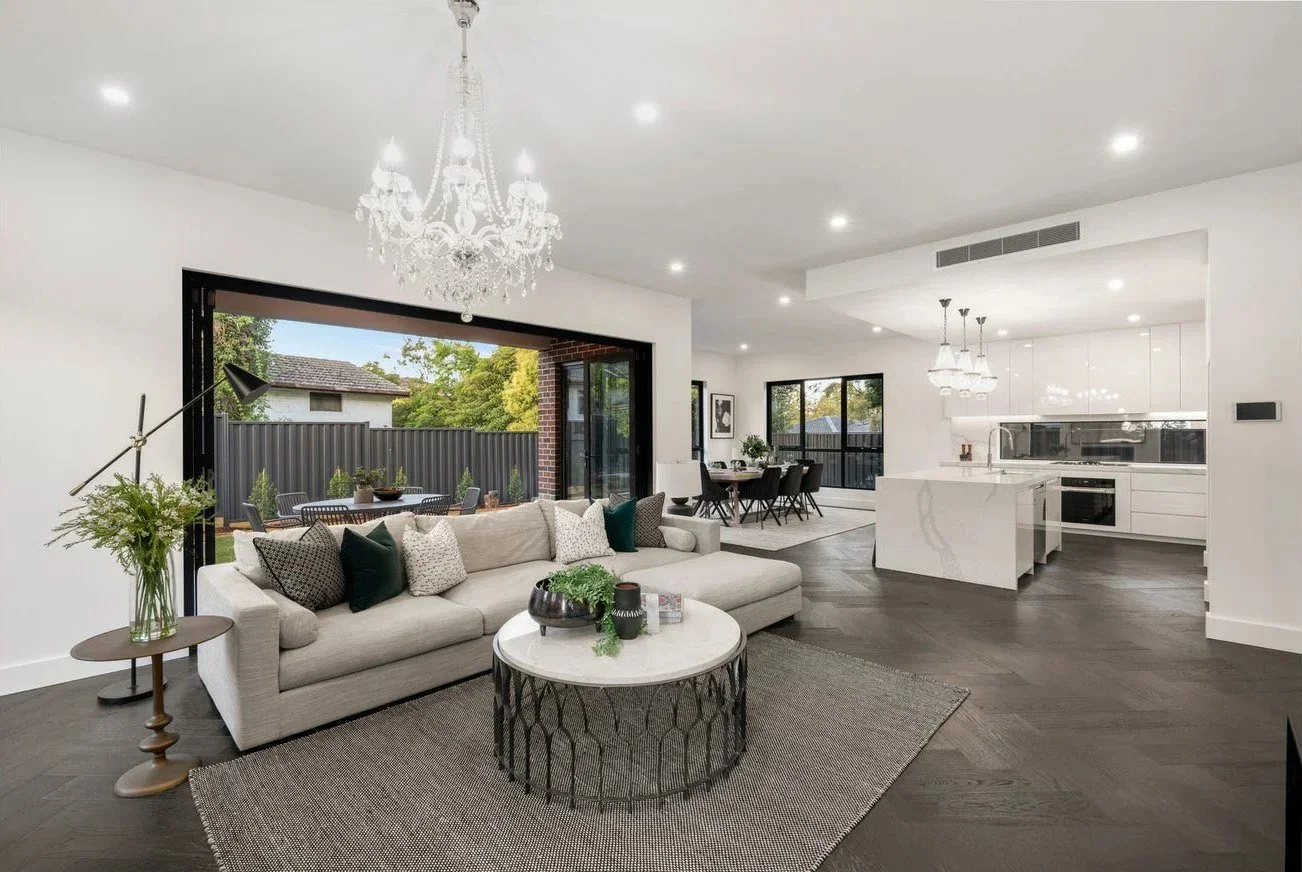
A finished home tells you more about a builder than any display village can.
What is different about building in the south east
A builder can tick every regulatory box and still be the wrong fit for your block. Local experience matters here for a few reasons.
Reactive clay. Much of Melbourne sits on clay that moves with moisture, and parts of the outer south east are known for highly reactive ground. The soil test and the footing design are where a lot of long-term problems are prevented or caused. Ask how the builder handles slab design on reactive sites, and read our guide to building on reactive clay in Melbourne. Our founder Sher Baloch comes from a structural engineering background, and it shows in how closely we look at this.
Council processes vary. Councils run their own asset protection permits, crossover permits and local laws. In Greater Dandenong, for example, removing a private tree with a trunk of 40 centimetres or more at 1.4 metres above ground needs a council permit. A builder who works in your council area regularly will price these properly and know the timelines. Our guide to building in Greater Dandenong shows how much local detail is involved.
Planning has changed fast. New activity centre zones now apply around Springvale, Noble Park, Yarraman and Dandenong stations, and the state's single dwelling and townhouse codes were reworked in 2025 and again in September 2026. Ask whether the builder has recent experience with the rules that apply to your site.
Established streets. In established suburbs like Rowville, Wheelers Hill, Clarinda and Dandenong North, where we have built for local families, a custom home usually means a knockdown rebuild on a street where neighbours live metres away. Site management, protection works and communication with neighbours matter more than they do in a new estate.
Visit finished homes and showrooms
Display homes show you a builder's best-dressed product. Finished homes that real families live in show you how the builder handles the details.
Visit a live site as well. A tidy, well-organised site usually reflects a well-organised builder. Then spend time in the showroom where you would make your selections. At our K Studio showroom in Noble Park, selections happen across two appointments, one for electrical and one for finishes and interiors, with our in-house interior designer Nikki. You can see examples of finished work on our projects page.
If something goes wrong later. The BPC runs a free domestic building dispute resolution service, previously known as DBDRV. Its officers conciliate between owners and builders, and if that fails the BPC can issue binding orders or a certificate that lets you take the dispute to VCAT.
Common questions
How do I check if a builder is registered in Victoria?
Use the Building and Plumbing Commission's "Find and check a practitioner" page and search by name, business name or registration number. For a new home, look for Domestic Builder (Unlimited) registration and check that the company on your contract is also registered. Then check the BPC's Compliance and Enforcement Register.
What is the maximum deposit a builder can ask for in Victoria?
For a contract of $20,000 or more, the deposit cannot be more than 5 percent of the contract price. For contracts under $20,000 the cap is 10 percent. Asking for more is a breach of the Domestic Building Contracts Act and a reason to walk away.
Do I still need domestic building insurance in 2026?
For contracts signed on or after 1 July 2026, domestic building insurance has been replaced by Home Warranty, provided by the BPC for eligible work over $20,000. The builder pays the premium and the BPC sends you a Notice of Cover. Contracts signed before that date stay under the old DBI scheme.
How long is the cooling-off period on a building contract in Victoria?
Five business days from when you receive a copy of the contract signed by the builder. If you withdraw, you get your deposit back less $100 and any out-of-pocket expenses you approved. There is no cooling-off period if a lawyer reviewed the contract before you signed.
How many quotes should I get for a custom home?
Two or three is enough if they are based on the same drawings and specification. More quotes on different designs just make comparison harder. Spend the time comparing provisional sums, site costs and inclusions instead.
What we would do in your shoes
Run the register checks first, because they take ten minutes and rule out the builders you should never have been talking to. Then meet the shortlist in person, see their finished work, and read the contracts side by side. Choose the builder whose answers are specific and written down.
We build custom homes across Melbourne's south east and take on a limited number each year, with the same team from first meeting to handover. If you are comparing builders and want a straight conversation about your block, get in touch. Bring your questions from the list above. We would rather answer them before you sign than after.
Sources
- Find and check a practitioner, Building and Plumbing Commission
- Home Warranty, Building and Plumbing Commission
- Home Warranty premium and Notice of Cover, Building and Plumbing Commission
- Building companies and partnerships, Building and Plumbing Commission
- Deposits and payments for building work, Consumer Affairs Victoria
- Getting out of a building contract checklist, Consumer Affairs Victoria
- Dispute resolution services, Building and Plumbing Commission